When the River Rises: Scurlock Farms Survives Another Historic Flood –
July 4, 2025
Like many of you, we’ve watched the heartbreaking news coverage of the devastating July 4th flood in the Texas Hill Country. The loss of life and destruction in Kerrville and surrounding communities is difficult to comprehend, and our hearts go out to everyone affected.
Scurlock Farms also sustained significant flood damage. Thankfully, every bit of it can be repaired, and most importantly, no lives were lost.
On the morning of July 5, Dan and I were headed to breakfast when I suggested taking the scenic route so we could check the San Gabriel River at Mankin’s Low Water Crossing. When we arrived, the crossing was already underwater. Four county sheriff’s vehicles and an ambulance were parked at the nearby mobile home park, and we immediately knew something serious was unfolding.
We stopped to ask one of the deputies what was happening. He told us that the river had already crested at 30 feet upstream, and all of that water was headed toward us. Deputies were urging residents of the mobile home park to evacuate before the floodwaters arrived. That was the first indication we had that our own farm was in danger.
Just a half-mile downstream from Scurlock Farms was another mobile home park with about 30 trailers. Tragically, only three of them were able to escape before the floodwaters arrived.
As soon as we left, we called our youngest son, David, who also lives on the farm. He had a herd of Aberdeen Angus cattle grazing in our 20-acre pecan orchard along the river. David and Foster immediately drove down to check on them. Water had just begun flowing into the orchard.
They walked toward the river to assess the situation, but when they turned around only five minutes later, the water had already spread across several rows of pecan trees. The river was rising at an alarming rate.
David raced back to the barn, loaded a large round bale of hay onto the tractor, and drove back into the orchard. Fortunately, the cattle followed the hay bale up the hill to our upper pastures, safely 30 to 40 feet above the river bottom. Their quick actions almost certainly saved the herd.
That rescue carried special meaning for us.
Our pecan orchard sits in the San Gabriel River bottom, about 35 feet above the normal river level. During the historic 2010 “500-year flood,” we lost three cows when floodwaters swept them away. We had only recently agreed to purchase the herd from a friend for $1,000 per cow and hadn’t even paid for them yet. We hoped he might share part of the loss, but he didn’t, so we ended up paying the full $3,000 for the animals we never had the chance to keep.
This time, thanks to David’s quick thinking, every cow made it safely to higher ground.
By the time the San Gabriel crested at approximately 36 feet, the entire pecan orchard was underwater. Even the highest parts of the orchard, farthest from the river, had nearly two feet of water. Along the river bluff, the water was considerably deeper.
As the floodwaters receded, they left behind an incredible amount of debris tangled in our half-mile-long north fence bordering the river. Thankfully, that fence is barbed wire rather than woven goat wire. The open design allowed much of the water to pass through instead of acting like a net that could have torn the entire fence away.
We learned that lesson during the historic 2010 flood, when we had to completely replace the entire half-mile of river fencing.
Although many steel fence posts were bent by the force of the current, the barbed wire itself remained standing beneath piles of branches, brush, and debris. Repairing it was far easier than rebuilding the entire fence.
The east and west fences were another story. Those woven goat-wire fences were flattened by the rushing water, and numerous steel T-posts had to be replaced. David and Foster unclipped the fencing, installed new posts, and then stretched and reattached the wire.
One unexpected blessing came from a young woman who happened to be staying at Scurlock Farms. She volunteered to spend the day helping with the fence repairs, and David was incredibly grateful for the extra set of hands.
The following day, we had another challenge. Because the side fences were still damaged, the cattle could easily wander back into the orchard and onto neighboring property. We quickly installed a gate and built nearly 400 feet of temporary fencing using whatever materials we could find around the farm—dog kennel panels, livestock panels, heavy-duty cattle panels, and new fencing for the remaining distance.
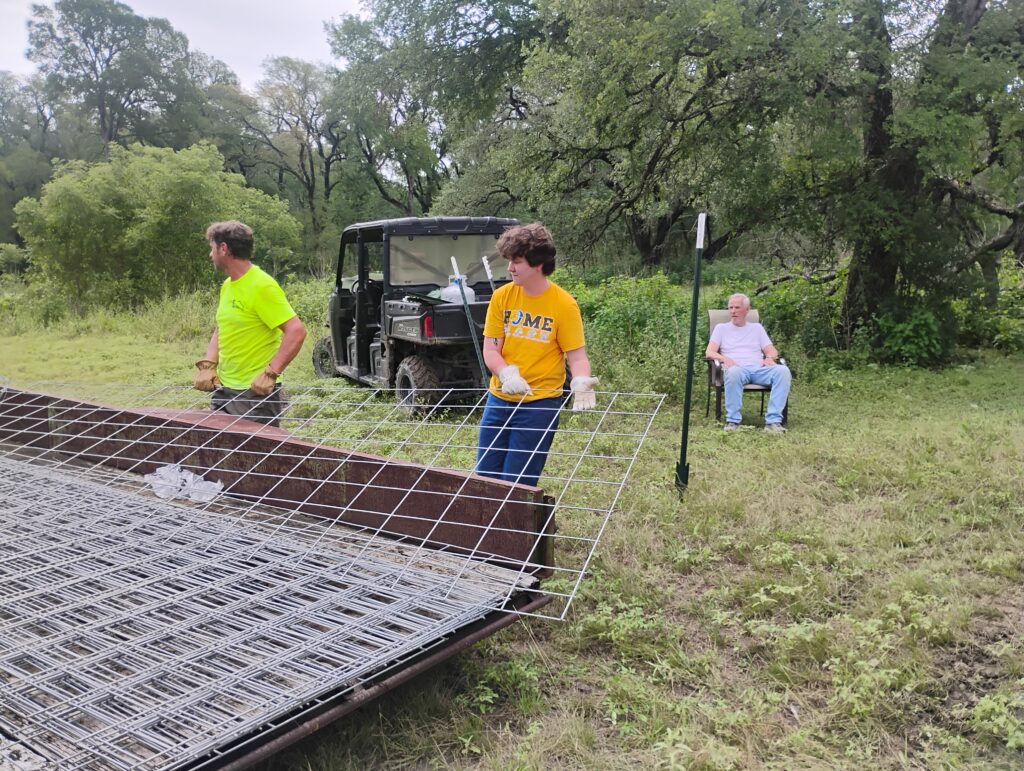
Thankfully, the round bale of hay kept the cattle content in the upper pasture while we finished the repairs.
Living on the San Gabriel River has taught us to respect its beauty and its power. Floods are part of life here, but each one reminds us how quickly conditions can change and how important preparation, experience, good neighbors, and a little luck can be.
This flood left Scurlock Farms with plenty of work ahead, but it also left us with overwhelming gratitude. Buildings can be repaired. Fences can be rebuilt. Trees will recover. Most importantly, every member of our family—and every one of our cattle—made it safely through another historic flood.
Views: 145




Leave a Reply